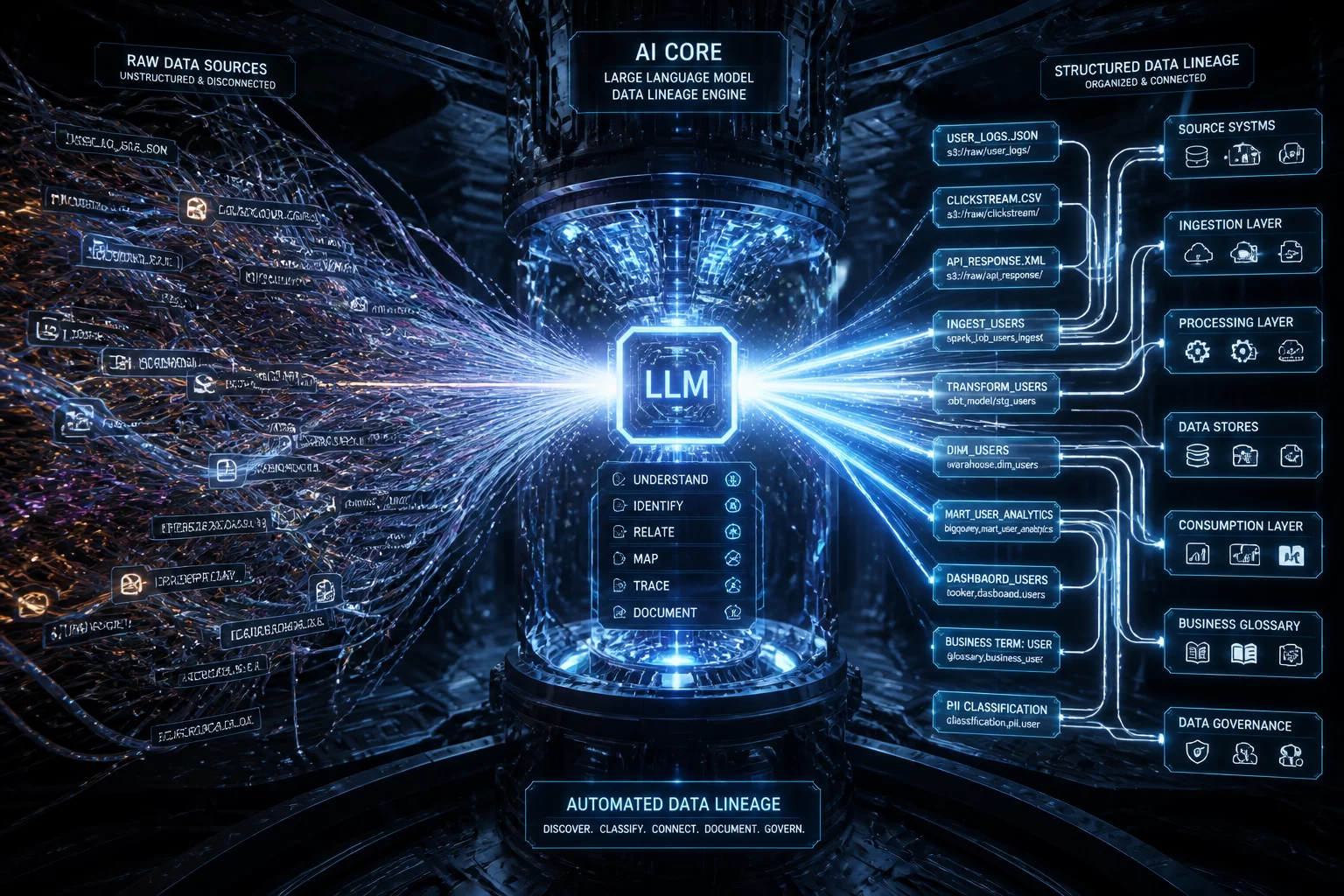
Large Language Models (LLMs) are transforming how engineering teams manage data lineage by automating the extraction of relationships from complex SQL dialects and legacy ETL scripts. This shift eliminates the bottleneck of manual documentation and provides a real-time view of how data moves from source systems to downstream analytics.
The Critical Need for Automated Lineage
In modern data architectures, a single change to a database schema can break dozens of downstream reports, machine learning models, and API endpoints. Traditional lineage tools often rely on static parsing, which struggles with dynamic SQL or poorly documented stored procedures. Teams frequently find themselves in a reactive cycle, fixing broken dashboards only after stakeholders report errors. Automation through LLMs changes this dynamic by proactively identifying dependencies that traditional parsers miss.
How LLMs Interpret Data Flow
LLMs excel at understanding the semantic intent behind code. When a data engineer prompts a model with a set of SQL scripts, the AI identifies not just the table joins, but the logic governing data transformations. It recognizes that a column named 'user_id' in one system is functionally identical to 'customer_num' in another, even without explicit foreign key constraints. This semantic understanding allows for the construction of a high-fidelity lineage graph that reflects the actual state of the data ecosystem.
Key Benefits of AI-Enhanced Analysis
Implementing LLM-based lineage analysis offers several strategic advantages for data-driven organizations:
- Accelerated Impact Assessment: Engineers can run what-if scenarios to see exactly which BI tools will be affected by a proposed schema migration.
- Improved Data Trust: Stakeholders gain confidence in their reports when they can trace every metric back to its authoritative source.
- Legacy System De-risking: AI can parse decades-old code to map dependencies in systems that no longer have active owners.
- Automated Documentation: The system generates human-readable descriptions of data flows, keeping the internal wiki updated without manual effort.
Steps to Integrate LLMs into Lineage Workflows
Transitioning to an automated lineage model involves a structured approach to metadata management. Follow these stages to ensure accuracy and scalability.
- Collect Metadata and Code: Gather all DDL statements, stored procedures, and transformation logic into a centralized repository.
- Standardize Input Formats: Clean the code snippets to remove sensitive data while preserving the structural logic for the model to analyze.
- Execute Semantic Extraction: Use specialized prompts to ask the LLM to identify source-to-target mappings and transformation rules.
- Validate and Visualize: Feed the extracted relationships into a graph database to create an interactive map of the data lineage.
- Monitor Continuously: Set up triggers that re-analyze code whenever a pull request involves a schema change.
Overcoming Accuracy Challenges
While LLMs are powerful, they are not infallible. Hallucinations can lead to the identification of non-existent relationships. It is essential to treat AI-generated lineage as a high-quality suggestion that requires a human-in-the-loop for final verification, especially in highly regulated industries. Combining LLM insights with traditional metadata validation creates a robust hybrid system that balances speed with technical precision.
Comments & Discussion
No comments yet. Be the first to leave a comment.
Leave a message