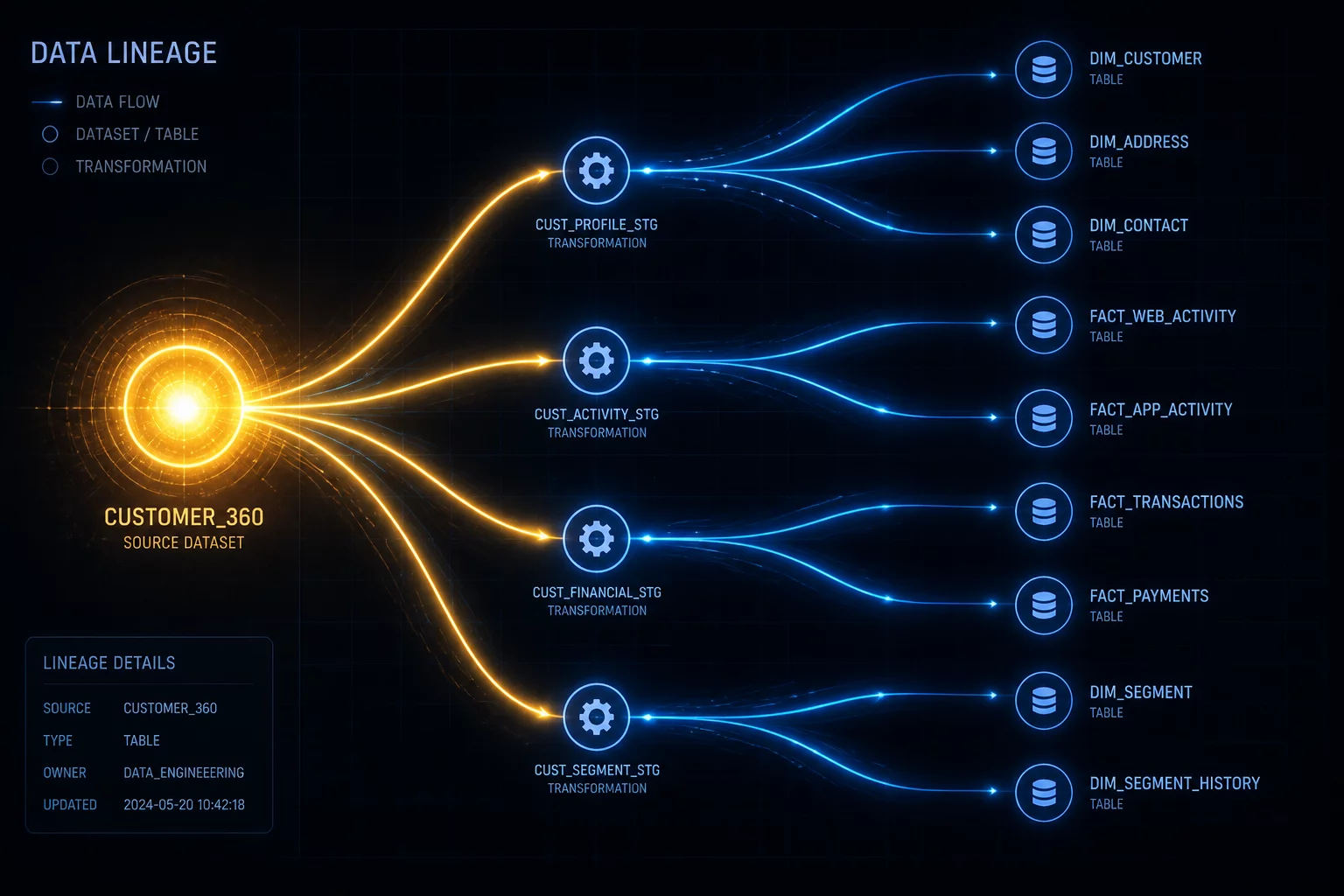
Data lineage and source change assessment are fundamental practices for maintaining data integrity in complex corporate environments. By tracing the path of data from its birth in a source system to its eventual use in a BI dashboard or API, engineers can predict exactly which reports will break when a schema changes. A source change assessment is the proactive evaluation of these impacts before a migration is deployed to production.
The Critical Role of Data Lineage in Migrations
Without a clear map, database migrations are a dangerous guessing game. Modern analytical stacks often involve multiple layers of transformation (ETL/ELT). A small change at the source, like altering a TIMESTAMP to a DATE, might seem trivial to a backend developer. However, it could crash a financial forecasting model that relies on millisecond precision or invalidate historical trends stored in a downstream data warehouse. Lineage provides the visibility needed to avoid these silent failures.
Executing a Source Change Assessment
A structured assessment should follow a repeatable workflow to ensure no downstream dependency is missed. First, identify the specific objects being changed in the source database. Second, query the lineage metadata to find all direct and indirect dependencies, including views, stored procedures, and external BI tools. Third, notify downstream owners such as data scientists and BI analysts about the upcoming shift. Finally, run a shadow migration in a staging environment to validate that downstream pipelines still function as expected.
Common Downstream Risks
When a source schema evolves, the risks are not always binary (broken vs. working). Often, the risk is semantic. A column name might remain the same, but the logic behind the data could change, leading to inaccurate reporting that goes unnoticed for weeks. Other risks include performance degradation if a new indexing strategy at the source doesn't account for analytical query patterns, or permission issues if the migration alters ownership of key tables.
Automating the Discovery Process
Manual lineage tracking is unsustainable in large organizations with thousands of tables. Modern observability tools that parse SQL logs and code repositories can automatically build these maps. These systems provide real-time visibility into the "blast radius" of any proposed database update, allowing teams to collaborate on changes rather than working in silos. Automation ensures that the lineage remains an accurate reflection of the current system state.
Comments & Discussion
No comments yet. Be the first to leave a comment.
Leave a message